The novella Fledging by Rose Diell, out next week from Renard Press, opens with Lia suffering severe abdominal cramps. And then she births(?) an egg. She is disgusted and fascinated by it, but does the only humane thing one can do: she builds it a warm nest.
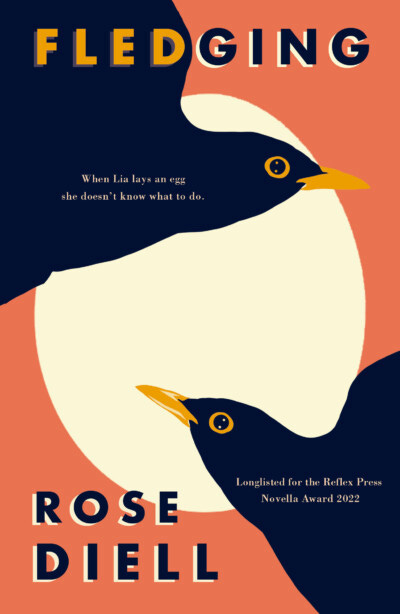
Apart from the egg-laying, the story is familiar. Lia is an ordinary woman in her thirties. She lives in London with her long-term boyfriend, has a small circle of friends, a job she finds moderately appealing, and a dream career she chases during most of her spare time. But, she is approaching the age when she must decide whether she wants to have children.
While the egg itself seems too wild to fit into this story, it somehow works. I found I accepted its existence twenty or thirty pages in. It didn’t matter how it happened or what it meant or what might come out of it — it was simply there, giving Lia a glimpse of the sacrifices she might make if she became a mother.
The baby question is central to the novel. It haunts Lia throughout, because she owes her boyfriend (who is away for work) an answer about whether they will have kids. She discusses it with her friends and her mother, who all seem to see motherhood as more rewarding than compromising. The fact that Lia is secretly nesting an egg in her living room while she solicits this advice is known to no one.
When Lia holds her best friend’s baby, she tries to imagine what it would be like to have her own.
“I looked down at him, pictured him mine. Pictured nursing this little creature, being with him at my waking and my sleeping. I was vaguely aware that I was supposed to feel something.” p. 47
Later, another friend is asking about her plans for children. All around Lia, she is bombarded with inquiries. In the novel, it feels a little absurd that everyone she knows is asking this question, but it is not too far-fetched to frequently witness this conversation among women in their thirties. When her friend advises not to “leave it too late,” Lia thinks:
“Perhaps there’s something wrong with me, too, I think. Not just with my womb. With my heart.” p.109
Compared to Motherhood by Sheila Heti, for example, Fledging is far more character-driven than philosophical, yet still exists (it seems) to directly address this life-changing question. The novel is riddled with all the usual arguments for having children, and for not. Any woman of this age will have heard it all, but it is reassuring to consider each perspective through the lens of this one character. Lia feels like a real person, friendly with her neighbors, supportive of her community, worried about her mother’s well-being. While Fledging is particular in terms of the theme, it is refreshing to wrestle this question with an ordinary (in the best way) character.


